
Can an AI Symptom Checker Replace a Doctor? What the Evidence Actually Says
No — an AI symptom checker does not replace a doctor. It is a triage and education tool, not a diagnosis, and the clinical research behind these tools, including the widely cited Semigran 2015 BMJ study, backs that distinction up.
The honest answer depends on context — it matters most when you’re deciding which symptoms are true emergencies, and it changes how to use one before a doctor visit.
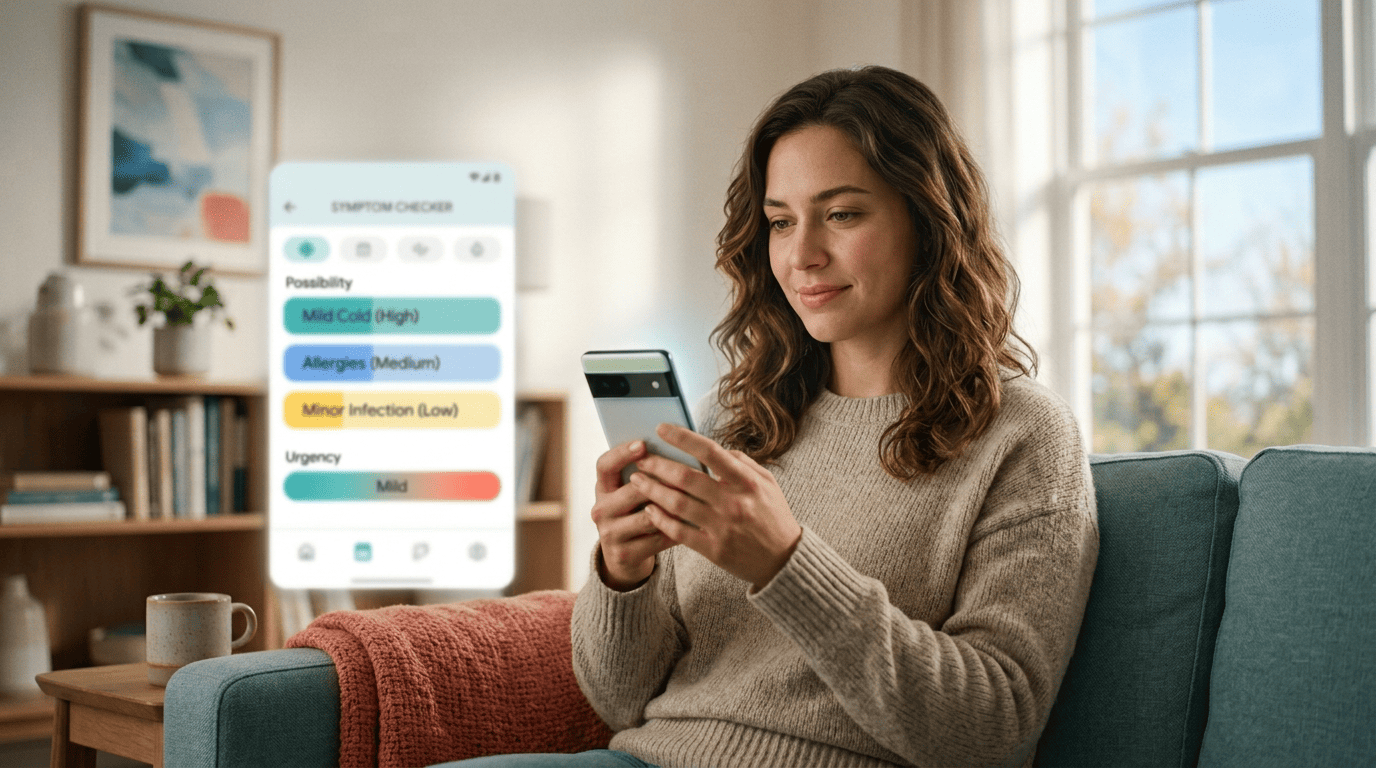
That doesn’t make it useless. Used the right way, an AI-based symptom checker helps you decide whether you need care and how urgently — this article walks through the accuracy numbers, what a physician does that software cannot, and exactly when to stop typing and call 911.
Medical disclaimer: An AI symptom checker is not a substitute for a licensed physician and does not provide a diagnosis. It is an informational triage tool only. Call 911 (or your local emergency number) for any emergency. If you have red-flag symptoms — chest pain, trouble breathing, signs of stroke (face drooping, arm weakness, slurred speech), severe bleeding, sudden severe pain, or a high fever that won’t come down — seek immediate in-person care. Always confirm anything you read here with a qualified healthcare professional.
What an AI Symptom Checker Actually Does
An AI symptom checker asks a series of questions about what you’re experiencing, then returns a ranked list of possible conditions along with a recommendation for the right level of care — self-care, an appointment with a doctor, or emergency treatment. That output is triage and education, not a diagnosis. Google’s health VP has said the search engine fields more than a billion health-related questions a day — roughly 70,000 every minute — and a large share of patients look up their symptoms online before ever seeing a clinician.
The market splits into two camps: rule-based tools such as WebMD Symptom Checker and Isabel, which walk users down fixed decision trees, and AI/ML-driven tools such as Ada Health, Ubie, Symptomate (built on the Infermedica engine), Buoy Health, and Docus AI, which use probabilistic models trained on clinical data.
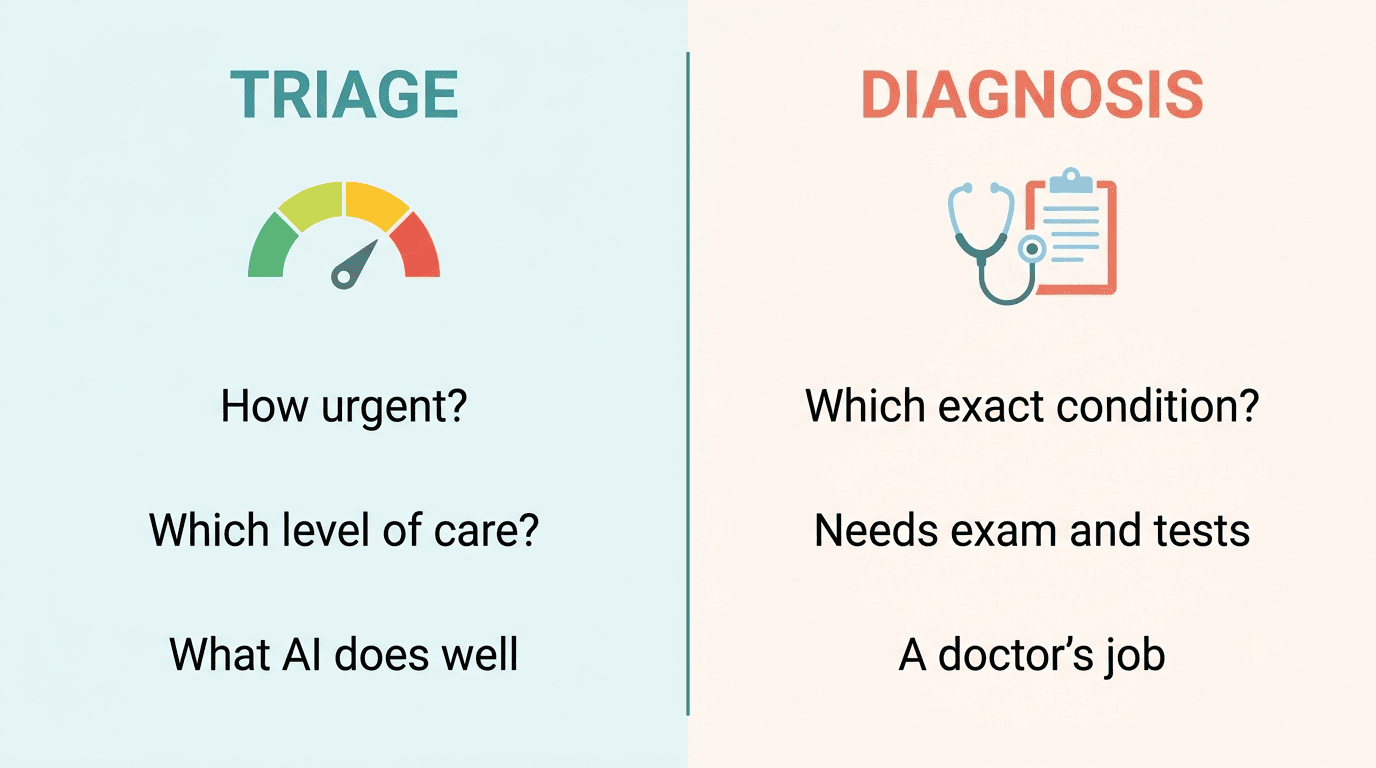
It maps symptoms to possibilities, then triages
The underlying logic is the same across most digital triage tools: collect symptoms, ask clarifying questions, compare the pattern against a knowledge base, and surface likely explanations ranked by probability. A symptom checker app is deliberately conservative — it’s built to flag anything that could be serious rather than commit to a single answer, because the cost of missing an emergency is far higher than the cost of an extra doctor visit.
A typical session follows the same basic sequence regardless of which tool you use:
- Enter your main symptom and any obviously related ones
- Answer a series of follow-up questions (duration, severity, associated symptoms, medical history)
- Review the ranked list of possible conditions the tool returns
- Read the triage recommendation — self-care, schedule a doctor, or seek emergency care
- Act on the urgency level, not just the named condition
Diagnosis vs triage — the distinction that changes everything
A diagnosis identifies the specific condition a patient has, and only a physician can make that call after an exam, history, and often lab work or imaging. Triage is a narrower question: how urgent is this, and who should see it? Across the research, symptom checkers are consistently better at triage than at diagnosis. That’s the single most important framing for anyone using an online symptom checker: ask «how soon should I see someone,» not «what disease do I have.»
How Accurate Are AI Symptom Checkers?
| Tool | Reported top-3 / top-10 accuracy |
|---|---|
| Ada Health | ~70.5% top-3 |
| Ubie | 71.6% top-10 |
| Buoy Health | ~43% top-3 |
| WebMD Symptom Checker | ~35.5% top-3 |
| Babylon | ~32% top-3 |
| Symptomate (Infermedica) | ~27.5% top-3 |
Diagnostic accuracy: modest, and it varies a lot
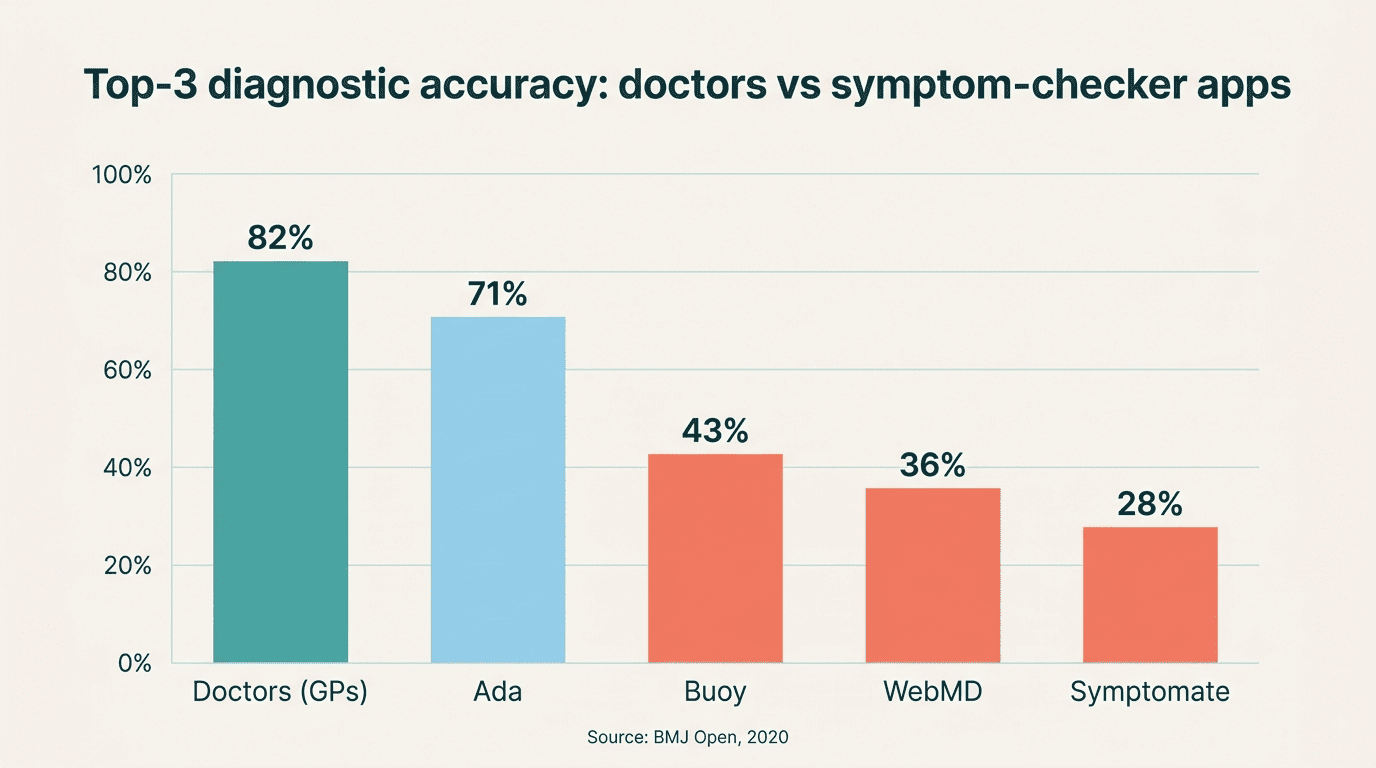
The benchmark study most often cited is Semigran et al., published in BMJ in 2015: researchers tested 23 symptom checkers against 45 standardized clinical vignettes and found the checkers listed the correct diagnosis first only about 34% of the time — rising to 58% when looking at the top 20 possible diagnoses. Later systematic reviews put average diagnostic accuracy for the primary (first-listed) diagnosis across tools in a wide 19-36% range. Individual products vary widely — a 2020 BMJ Open clinical-vignette comparison against GPs found Ada Health scoring roughly 70.5% top-3 accuracy, Buoy Health about 43%, WebMD around 35.5%, Babylon near 32%, and Symptomate close to 27.5%, versus an average of 82.1% for the GPs reviewing the same cases. Ubie separately reports 71.6% when measured against a top-10 list rather than top-3, in its own 2024 clinical-vignette study. It’s worth underlining that «top-3» or «top-10» accuracy is not the same as «got it right on the first try» — a criticism raised repeatedly against how vendors present these numbers.
Triage accuracy: better, but still imperfect
Triage performance is noticeably stronger than diagnostic performance: reported triage accuracy across studies ranges from 48.8% to 90.1%. In the original Semigran analysis, appropriate triage advice was given about 57% of the time, with individual tools ranging from 33% to 78%. The takeaway is consistent — an AI symptom checker is more reliable at telling you how urgent a situation is than at naming the exact condition. Even so, it’s far from perfect, and underestimating urgency is more dangerous than overestimating it.
Where accuracy collapses: rare and complex cases
Accuracy drops noticeably on rare or complex presentations — a 2022 systematic review found correct diagnosis of infectious-disease scenarios specifically ranged from just 3% to 16% across tools, far below the average for common conditions. A few situations sit consistently outside what any digital triage tool can reliably handle:
- Rare or unusual diseases with few clinical vignettes to train against
- Multi-symptom presentations where conditions overlap or mask each other
- Anything that genuinely requires a physical exam to assess (swelling, tenderness, skin texture)
- Cases that depend on lab results or imaging rather than reported symptoms alone
This is exactly where false confidence from an app becomes most dangerous.
What a Doctor Does That AI Cannot
A physician doesn’t just pattern-match symptoms against a database — they observe, listen, palpate, order and interpret tests, and weigh a patient’s full history and context, a combination clinicians call «clinical gestalt.» The 2020 BMJ Open clinical-vignette study cited above found physicians reaching roughly 82.1% diagnostic accuracy on average, versus about 38% across the eight symptom-checker apps tested on the same cases. A broader meta-analysis found that AI tools perform on par with non-expert physicians but significantly worse than expert clinicians.
But in many cases, users should be cautious and not take the information they receive from online symptom checkers as gospel.
Dr. Ateev Mehrotra, Harvard Medical School
Physical exam, context, and clinical judgment
An exam catches things a text-based symptom list never will. A physical visit typically includes:
- Listening to the heart and lungs for sounds a patient can’t describe in words
- Palpating the abdomen or affected area for tenderness, swelling, or masses
- Examining a rash, wound, or lesion directly rather than from a text description
- Reviewing medical history, current medications, and family history for interactions or risk factors
- Ordering and interpreting labs or imaging when the picture isn’t clear from the exam alone
Doctors also weigh a patient’s affect and context — details a checker rarely has full access to.

Follow-up, accountability, and the doctor–patient relationship
A doctor observes how a condition evolves over days or weeks, adjusts the plan, and is accountable for the outcome. A symptom checker gives a one-time snapshot with no follow-up — which creates risk of «diagnostic momentum,» where an early AI-generated hunch anchors a patient’s thinking, plus confirmation bias from a black-box tool that hasn’t learned anything about that specific patient. No consumer AI chatbot — not ChatGPT, not Gemini, not Perplexity — is cleared for clinical diagnosis.
The Risks of Treating a Symptom Checker Like a Doctor
False reassurance and delayed care
The biggest risk isn’t over-alarm — it’s false reassurance. A checker that returns a mild, plausible explanation can lead someone to postpone care for something serious: missed infections, cancers caught later than they should be, or vascular events like stroke and heart attack. The opposite failure mode also exists — excessive anxiety and symptom hyperfixation, a pattern researchers have linked to health-anxiety and hypochondria-like behavior.
Bias, privacy, and physician concerns
Training data bias. Models trained on incomplete or skewed datasets tend to perform worse for underrepresented populations, which can widen existing gaps in care.
Opaque reasoning. Most consumer tools don’t show why a particular result was ranked highest, which makes it hard for a user — or a doctor reviewing the output — to judge how much weight to give it.
Data privacy. Health data entered into a symptom checker app raises questions about storage, sharing, and consent that vary a lot by vendor.
Physicians themselves are wary. A Sermo survey found that 95% of doctors have at least one concern about how much patients rely on AI health tools, with 47% citing risk of misdiagnosis or delayed care as their single biggest worry — even though 42% describe themselves as cautiously optimistic about AI’s role in care overall.
When to Use an AI Symptom Checker — and When to See a Doctor
This is the practical part every reader actually needs: a quick reference for matching the situation to the right response.
| Situation | What to do |
|---|---|
| Mild, familiar, non-urgent symptoms | Start with an AI symptom checker for guidance |
| Persistent, worsening, or unexplained symptoms | Schedule an appointment with a doctor |
| Chest pain, stroke signs, severe bleeding, or other red flags | Call 911 immediately — skip the app |
Green light: reasonable times to start with a checker
- Mild, familiar, non-emergency symptoms — a cold, a minor rash, a question about which specialist to see
- Preparing for an upcoming appointment by organizing your symptoms and questions in advance
- Getting an initial read on how urgent a situation might be before deciding next steps
Treat the checker as a first step, never a last one.
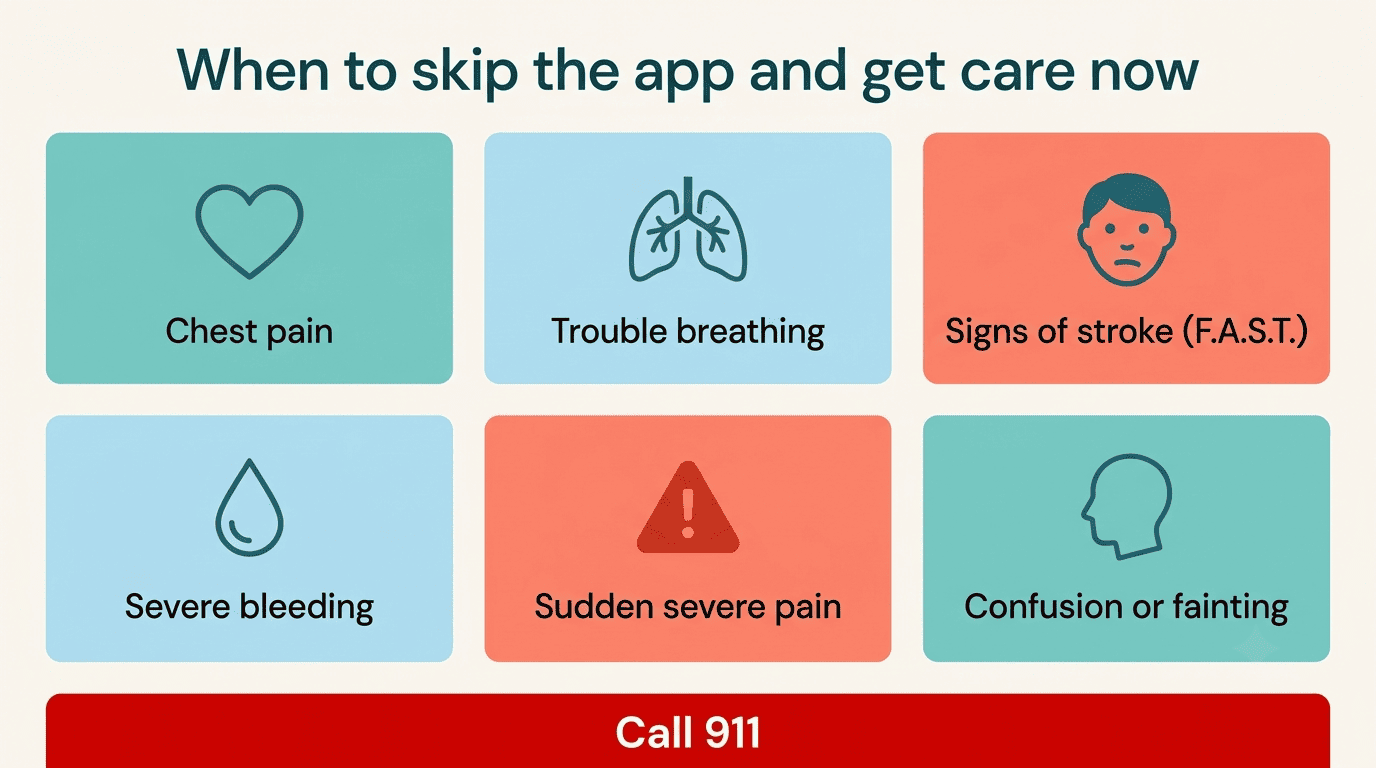
Red light: go straight to care, skip the app
Certain symptoms call for immediate action, not more questions typed into a phone. Remember the FAST rule for stroke and act fast on any of the following:
- Chest pain or pressure
- Trouble breathing
- Signs of stroke — Face drooping, Arm weakness, Speech difficulty: Time to call 911
- Severe or uncontrolled bleeding
- Sudden, severe pain
- Confusion or loss of consciousness
- Suicidal thoughts
- A high fever in an infant that won’t come down
If any of these apply, call 911 — don’t spend time in an app first. Symptoms that are chronic, worsening, or unexplained over time should prompt a scheduled visit to a doctor rather than repeated app checks.
How to Use an AI Symptom Checker Safely
Treat it as a first step, then verify with a clinician
Use it as a second opinion, not a verdict. Enter complete, honest information rather than the mildest possible version of your symptoms, and don’t self-treat based on whatever the tool returns — verify with a physician.

Prefer tools with transparent sourcing. Where available, check for regulatory status such as FDA clinical decision support classification, and favor products that explain how a result was reached rather than presenting a bare list.
Remember the accuracy ceiling. The highest diagnostic accuracy in the research comes from a hybrid model — AI generating a second opinion that a physician then reviews — not from either one working alone.
The realistic future: AI + doctor, not AI vs doctor
The direction the field is actually moving is toward AI as a safety net and accelerator for physicians — catching things that might get missed and helping prioritize patients in busy emergency departments — rather than a replacement for them. Dermatology offers a useful example: peer-reviewed studies have found AI image-analysis models matching or edging out dermatologists on melanoma detection in controlled comparisons, but that’s a narrow, well-defined task built into a clinical workflow, not a stand-in for self-diagnosis at home.